

Flexible solutions for every delivery model.
Improve project outcomes with construction intelligence solutions designed to work seamlessly with your business processes.
Commercial
Protect your margin by catching commercial risk before it becomes a claim.
Weaver monitors contract exposure, cost trends, change order status, and billing across your entire project portfolio — giving your commercial team the early visibility they need to act on risk before it compounds, rather than reconciling surprises at project close.
- Identify cost overruns before they exceed your contingency
- Know your subcontract exposure before change orders compound
- Keep billing current and catch underbilling before month-end
- Build a defensible record before a dispute reaches arbitration

Contract Risk Analysis — Reads contract language to flag high-risk clauses and suggest protective edits before execution, reducing downstream exposure.
Clause Risk Scoring — Scores every contract clause for change exposure so negotiators and project executives can focus attention on the provisions that matter most.
Change Order Monitoring — Continuously analyzes project schedules and cost data during execution to identify cost growth trends and flag potential change order situations early.
Compliance Monitoring — Tracks contractual reporting and notification requirements across the project lifecycle and alerts teams to upcoming deadlines and missed obligations.
Notice & Deadline Extraction — Parses contract language to extract all reporting timelines, cure periods, and notice requirements and surfaces them as actionable calendar items.
Commitment Tracking — Monitors contract commitments, executed amounts, and pending changes against budget in real time for complete cost visibility.
Pay Application Review — Reconciles backup documentation against contract scope, verifies percent-complete claims, and flags overbillings or missing deliverables before approval.
Insurance & Bond Compliance — Verifies subcontractor insurance certificates, bond coverage, and endorsement requirements against contract terms throughout the project lifecycle.
Dispute Documentation — Compiles and organizes contemporaneous project records into structured packages to support claims, mediations, or legal proceedings.
GC Services Agreement
Version 3.2Open actions: 8 Open items: 4
Risk Clauses
Notice & Deadlines
Compliance
Get started with Weaver Commercial
Talk to our team about how Weaver can support your program.
Construction
Give your field team the clarity to build right the first time.
Weaver connects field conditions to project data in real time — surfacing quality issues, workforce gaps, and daily progress deviations before they compound into costly rework or schedule slippage.
- Catch quality issues before they require rework or re-inspection
- Know your workforce and material status before it slows the field
- Keep subcontractor daily reports consistent and complete
- Tie field progress to schedule milestones in one view
Schedule Risk Detection — Monitors open RFIs, unapproved submittals, long-lead procurement, and workforce constraints against the schedule to surface risks before they cause delays.
Pre-Activity Safety Requirements — Tracks the full requirement matrix for high-risk activities — permits, certifications, JSAs — and flags gaps before work begins.
Real-Time Document Access — Gives field and office teams instant access to current-revision drawings, specs, and submittals from any device on the jobsite.
Scope Gap & Conflict Detection — Cross-references contract scope, design documents, and subcontract packages to surface gaps, overlaps, and unassigned work items.
Quality & Non-Conformance Management — Log field observations and deficiencies, assign corrective actions, and track resolution to closure with a full audit trail.
Daily Field Reporting — Capture and aggregate daily reports including manpower by trade, equipment, weather, and work-in-place directly from the field.
Construction Look-Ahead Reports — Auto-generate rolling look-ahead reports tailored to the field — highlighting upcoming activities, resource requirements, and predecessor constraints.
Material & Procurement Tracking — Monitors long-lead procurement against the schedule and flags items at risk of impacting critical path activities before they delay work.
Change Order Impact Analysis — Evaluates proposed change orders against the current schedule and budget to quantify downstream impacts before approval.
2-Week Construction Look-Ahead
PHX-DC-07 · Phoenix Data Center Campus · Week of Jun 23, 2026
Three critical-path activities begin this week: structural steel installation in Hall B, switchgear energization in MER-2, and continuation of above-ceiling MEP rough-in across Floors 2–4. Sequencing risk is elevated in MER-2 — a utility company inspection must clear by June 25 before energization can proceed. Hall B structural steel is the controlling predecessor to roof deck installation, which gates four downstream mechanical equipment lifts.
MEP rough-in on Floors 3–4 is tracking 4 days behind plan following rework on the chilled water distribution piping. Field teams should prioritize spool installation in gridlines C–F to recover schedule before the above-ceiling inspection window closes on July 5. Raised floor installation in MER-2 and generator set commissioning in the yard are the principal Week 2 activities requiring owner coordination.
Week 1 · Jun 23 – Jun 27
| Activity | Trade / Contractor | Start Date | Status |
|---|---|---|---|
| Structural Steel Installation — Hall B | Iron Workers / Turner GC | Jun 23 | On Track |
| Switchgear Energization — MER-2 | Electrical / Siemens Energy | Jun 25 | At Risk |
| Above-Ceiling MEP Rough-In — Floors 2–4 | Mechanical / Limbach Co. | Jun 24 | 4d Behind |
| Raised Access Flooring — Hall A Level 1 | Flooring / Tate Access Floors | Jun 24 | On Track |
| Fire Suppression Rough-In — Floors 1–2 | Fire Protection / Cosco Fire | Jun 25 | On Track |
| Roof Deck Installation — Hall B | Iron Workers / Turner GC | Jun 28 | Predecessor Open |
| IT Infrastructure Rough-In — Hall A | Low Voltage / Anixter | Jun 30 | On Track |
Week 2 · Jun 30 – Jul 7
| Activity | Trade / Contractor | Start Date | Status |
|---|---|---|---|
| Raised Floor Installation — MER-2 | Mechanical / Limbach Co. | Jun 30 | On Track |
| Electrical Conduit Pull — Gridlines C–F | Electrical / Siemens Energy | Jul 1 | On Track |
| Fire Suppression Rough-In — Floors 3–4 | Fire Protection / Cosco Fire | Jul 1 | Float: 2d |
| Concrete Topping Slab — Hall A Level 1 | Concrete / Webcor | Jul 2 | On Track |
| Chilled Water Pressure Test — Hall A | Mechanical / Limbach Co. | Jul 3 | Owner Sign-Off Pending |
| Above-Ceiling Inspection — Floors 3–4 | AHJ / City of Phoenix | Jul 5 | Hard Deadline |
| Generator Set Installation — Yard | Electrical / Cummins | Jul 7 | On Track |
| Crane Mobilization — Hall B Roof | Iron Workers / Turner GC | Jul 8 | Float: 3d |
Open Items Requiring Owner Attention
(1) Utility company inspection for MER-2 energization is scheduled for June 25 — any reschedule pushes energization into the following week and directly impacts IT infrastructure power-on sequencing in Hall A.
(2) Chilled water pressure test results from June 20 are pending owner review; sign-off is required before mechanical commissioning can begin in Hall A. Delay beyond July 3 compresses the above-ceiling inspection window.
(3) Above-ceiling inspection on Floors 3–4 is a hard AHJ deadline on July 5. MEP rough-in must reach inspection-ready status by July 4 to accommodate the city review window. Current 4-day lag requires recovery of at least 2 days in gridlines C–F this week.
(4) Crane mobilization window for Hall B roof is currently set for July 8. Hall B structural steel is the controlling predecessor — any delay beyond 3 days will compress float on the crane window and cascade to four downstream mechanical equipment lifts scheduled through July 14.
Get started with Weaver Construction
Talk to our team about how Weaver can support your program.
Documentation
Find any document, any version, in seconds — across your entire project.
Weaver centralizes drawings, submittals, RFIs, and correspondence into a single searchable source of truth, so your team always works from the right document and nothing slips through the cracks.
- Eliminate the risk of building from a superseded drawing
- Resolve RFIs and submittals before they delay field work
- Keep document logs current without manual tracking overhead
- Have a complete audit trail when disputes or claims arise

Multi-Source Aggregation — Pulls documents from project management systems, document control platforms, shared drives, and email into a unified, searchable project library.
Revision Comparison & Change Highlights — Compares any two versions of a document and surfaces exactly what changed — clause by clause, section by section.
Custom Review Checklists — Build reusable checklist templates for any document type and assign them to reviewers to ensure consistent, complete reviews every time.
Custom Document Summaries — Generates structured summaries of any document, extracting key dates, responsibilities, scope items, and risk flags automatically.
Full-Text Search Across the Project — Finds any clause, specification section, drawing note, or submittal detail across your entire document library in seconds.
Submittal & RFI Register — Tracks the full lifecycle of submittals and RFIs from issuance through approval, with automated reminders and overdue flags.
Distribution & Acknowledgment Tracking — Records which team members received each document version and confirms acknowledgment before critical milestones.
Version Control & Supersession — Automatically supersedes outdated document versions and maintains a full audit trail of every revision across the project.
Document Access Control — Manages view and edit permissions across document types, ensuring field teams, subcontractors, and owners access only what they're authorized to see.
Master Agreement
Version 3.2 · PHX-DC-07, Phoenix Data Center Campus · Executed Jun 1, 2026
This Master Agreement ("Agreement") is entered into as of June 1, 2026, between ContractorGeneral Contractor and Owner, for the design and construction of the Phoenix Data Center Campus.
Each party shall indemnify and hold harmless the other from any and all claims, damages, losses, and expenses, arising out of or resulting from its own negligent actsnegligent acts, errors, or omissions in the performance of this Agreement. This indemnification obligation shall survive termination of this Agreement.This obligation shall survive termination and shall not be limited by insurance coverage.
Written notice of any claim shall be delivered to the other party within fourteen (14)14 days→21 daystwenty-one (21) calendar days of the date the claiming party first became aware of the facts giving rise to such claim. Failure to provide timely notice shall not waive any rights but may limit the scope of recoverable damages under Section 9.4.
In the event that the General Contractor fails to achieve Substantial Completion by the required date of December 15, 2026, the Owner shall be entitled to liquidated damages in the amount of $2,500Five Thousand Dollars ($5,000) per calendar day of delay. The parties agree this sum represents a reasonable estimate of actual damages and shall not exceed, in the aggregate, ten percent (10%) of the Contract Sum.
The General Contractor shall maintain, at a minimum, the following insurance coverages throughout the duration of the Work: (a) Commercial General Liability of not less than $2,000,000$5,000,000 per occurrence; (b) Umbrella/Excess Liability of not less than $10,000,000.
All changes to the Work shall be authorized by written Change Order or Construction Change Directive executed by both parties within seven (7)ten (10) calendar days of receipt of a change request. Unauthorized changes shall not be compensable.
The Contract Sum for the Work described herein is One Hundred Forty-Two Million, Six Hundred Thousand Dollars ($142,600,000), subject to adjustment by properly executed Change Orders.
Revisions
Changed
Notice period, LD rate, insurance limits, CO response window
Added
Substantial Completion date, aggregate LD cap, survival clause extension
Removed
Original 14-day notice window, $2,500/day LD rate, $2M CGL limit
Moved
Insurance schedule relocated from Exhibit C to Section 8.1
Get started with Weaver Documentation
Talk to our team about how Weaver can support your program.
Environmental Health and Safety
Proactively manage Environmental Health and Safety compliance across every high risk activity.
Weaver identifies OSHA-recognized high risk activities on your project, checks prerequisite compliance before work begins, and flags gaps in permits, certifications, and safety plans — before incidents occur.
- Reduce liability exposure before an incident reaches your project record
- Stay prequalified — keep your OSHA recordables and EMR in check
- Know when a sub is out of compliance before it becomes your problem
- Resolve safety gaps before an inspector arrives — not after a stop-work order

Automatically flag OSHA-recognized high risk activities across every active work area on your project.
Verify that permits, JSAs, and trained personnel are confirmed before any high risk work begins.
Monitor TRIR in real time and benchmark your project against industry averages to stay ahead of risk.
Flag policy and compliance gaps in real time before they become recordable incidents.
Capture, classify, and route incidents immediately to keep your OSHA 300 log current and your response team informed.
Cross-reference active work against your project safety plan and flag any activities operating outside approved procedures.
Track corrective actions to closure — assign owners, set deadlines, and verify fixes before work resumes.
Monitor subcontractor safety qualifications — certifications, orientations, and training records in one place.
Surface leading indicators — observations, audits, and near-misses — before they become recordable incidents.
High Risk Activities
Activity
Working at Height
Workers performing tasks above 6 feet on scaffolding, ladders, or elevated platforms without adequate fall arrest systems.
Electrical Panel Exposure
Unguarded live electrical panels and exposed wiring in active construction zones creating arc flash and electrocution hazards.
Associated documents
Location
PHX-DC-07 / Module B / Generator Yard
Excavation & Trenching
Open excavations exceeding 5 feet in depth without adequate shoring, sloping, or protective systems.
Get started with Weaver Environmental Health and Safety
Talk to our team about how Weaver can support your program.
Scheduling
Keep your schedule on track before delays become change orders.
Weaver continuously monitors your project schedule, surfaces float erosion and critical path risk before deadlines slip, and gives your team the visibility to course-correct while there's still time.
- Spot critical path risk weeks before a deadline is missed
- Prevent delay claims with a documented schedule history
- Know which subcontractors are falling behind before it cascades
- Align your field team and owner on the same schedule picture

Schedule Merge — Combine schedules across projects, campuses, or your full portfolio into a single unified view for executive reporting and cross-project coordination.
Schedule Variance — Compare any two data dates and get auto-generated analysis of critical path changes, float erosion, and milestone drift.
Schedule Integrity — Run customizable integrity checks across your schedules and receive a scored report with prioritized findings.
Schedule Optimization — Leverage historical schedules to benchmark and assess activity durations, resource allocations, and sequencing logic.
Construction Look-Ahead Reports — Auto-generated reports that focus field and construction management teams on near-term critical activities.
Critical Path Analysis — Identifies and visualizes the critical path across your project schedule, surfacing activities with zero float that directly impact completion dates.
Delay Impact Assessment — Quantifies the schedule impact of delays and owner-caused events with activity-level forensic analysis to support claims and change orders.
Float Consumption Tracking — Monitors total and free float across all activities and alerts teams when buffers are being consumed faster than planned.
Baseline Comparison — Compares your current schedule against the original baseline and any approved revisions to track planned vs. actual progress across all milestones.
NV1 Building 1
NV1 Building 1 · Schedule Integrity Report · Jun 24, 2026
The current schedule submission recorded a composite health score of 15.5, a pass rate of 86.1% across 18 checks (15 passed, 1 OK, 2 failed), and 115 high-risk warnings concentrated entirely within a single check category: Relationship Type Validity. The Finish-to-Start (FS) predecessor ratio stands at 89.25%, falling below the required 90.0% threshold across 1,070 checked tasks, with 115 tasks lacking a valid FS predecessor.
The FS ratio of 89.25% falls below the 90.0% threshold — 115 of 1,070 checked tasks lack a valid Finish-to-Start link. Critical milestone tasks including Level 5 IST Complete (MIL-P2-000-1003), MBC Ready For Service (MIL-P2-000-1160), and Level 3 Commissioning Complete (MIL-P2-000-1321) carry FF or SF predecessor relationships instead of FS, weakening schedule logic integrity at program-defining events.
| Risk Finding | Check Category | Severity |
|---|---|---|
| FS Ratio Below Threshold (89.25% vs 90.0%) | Relationship Type Validity | Failed |
| Non-FS Links on Key Milestones (MIL-P2-000-1003, -1160, -1321) | Relationship Type Validity | Failed |
| Finish Milestone Logic — FIN-P2-000-1002 (FF link) | Relationship Type Validity | High Risk |
| Single Warning Category — 115 warnings | Relationship Type Validity | High Risk |
| 2 Failed Checks of 18 Total | Overall Health Score | Score: 15.5 |
Remediate all FF and SF predecessor relationships — convert to FS across the 115 flagged tasks to bring the ratio to or above 90.0%. Prioritize milestone logic corrections on MIL-P2-000-1003, -1160, and -1321. Address finish milestone logic on FIN-P2-000-1002 by converting the FF link to FS to remove ambiguity at project close-out.
Get started with Weaver Scheduling
Talk to our team about how Weaver can support your program.
Scope Management
Control scope from the first drawing set to the final punch list.
Weaver tracks every design change, addendum, and field deviation against your original scope — so your team always knows what changed, who approved it, and what it means for cost and schedule.
- Catch unapproved scope additions before they become disputes
- Reconcile every addendum and ASI before work is built wrong
- Know which subs have acknowledged the latest scope changes
- Close out punch items with a complete, documented trail

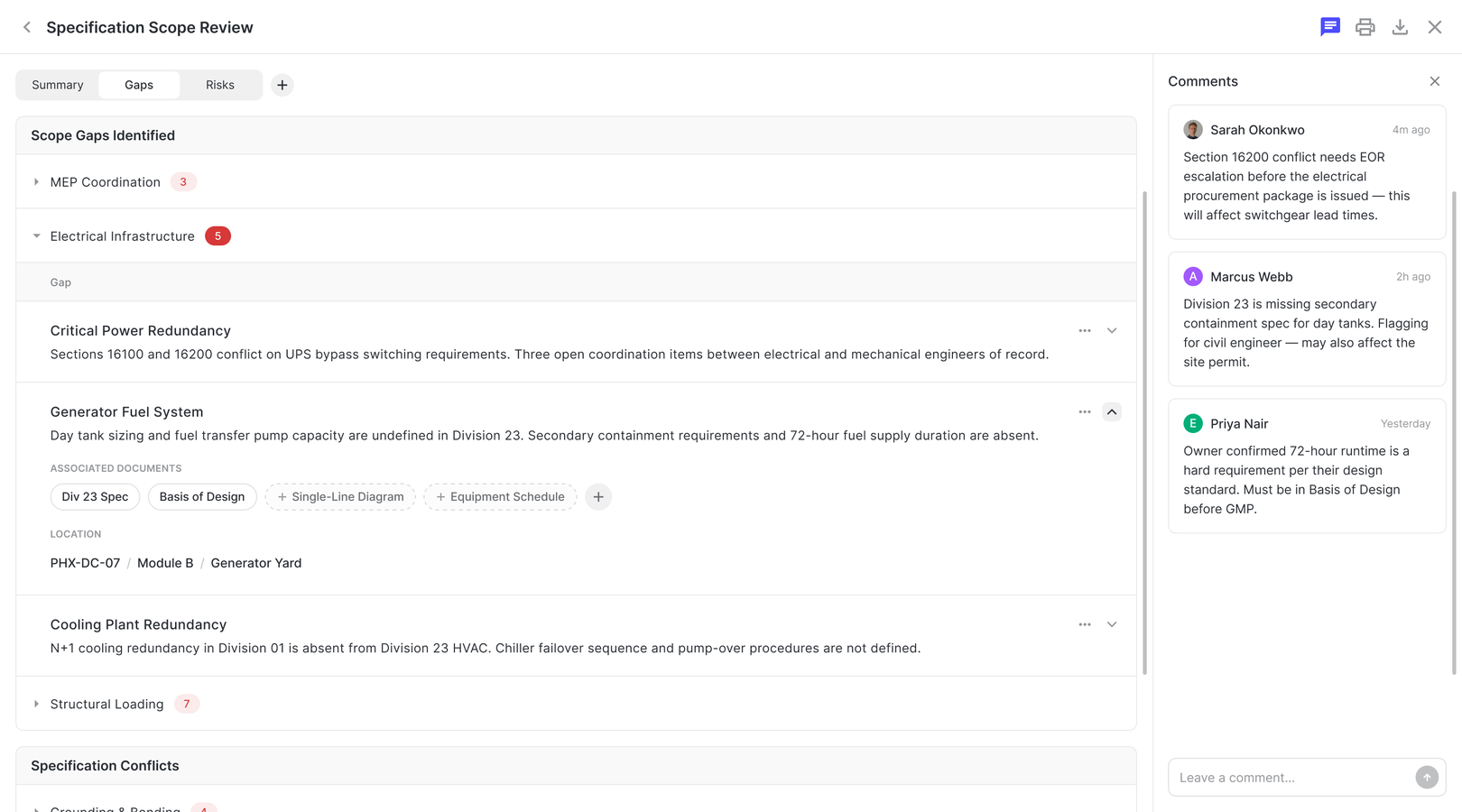
Scope Gap Analysis — Compares historical and current project documents to identify unassigned or excluded scope items before they become change orders or disputes.
RFI Identification — Analyzes specifications, drawings, and addenda to surface questions that need resolution before work begins, reducing field-level confusion and rework.
Specification Conflict Detection — Surfaces contradictions between spec sections, drawings, and contract exhibits that create ambiguity in scope interpretation.
Scope Creep Quantification — Compares document revisions across project phases to measure and attribute scope growth, providing the data needed to support change order entitlement.
Drawing Change Analysis — Compares drawing sets across revisions to identify added, removed, or modified scope elements that affect cost, schedule, or subcontract scope.
Addenda Reconciliation — Cross-references addenda against base bid documents to ensure all scope modifications were incorporated into the contract and subcontracts.
Scope Overlap Detection — Identifies areas of potential subcontractor scope overlap by comparing bid packages side by side against project drawings and specifications.
Pre-Construction Scope Review — Analyzes design documents and specifications during preconstruction to surface ambiguities, exclusions, and risk items before work begins.
Subcontractor Scope Alignment — Compares subcontract scopes against the prime contract to ensure all required work is included, distributed, and fully accounted for.
Get started with Weaver Scope Management
Talk to our team about how Weaver can support your program.