
Product Release
Introducing Weaver Patterns: The Intelligence Layer Built for Construction

Capital projects don't run into trouble for lack of information. The challenge is that the information they generate — RFIs, submittals, safety logs, schedule updates, change orders, inspection records — lives in silos. Separate systems, separate teams, separate reporting cadences. By the time it reaches the people who need to act on it, the moment to act has often already passed.
We recognized this pattern across programs of every size and sector. Owner teams were working from lagged reports. GCs were managing risk in isolation. The conditions that predict problems were being captured somewhere — just not in a form anyone could act on. We built Weaver Patterns to change that.
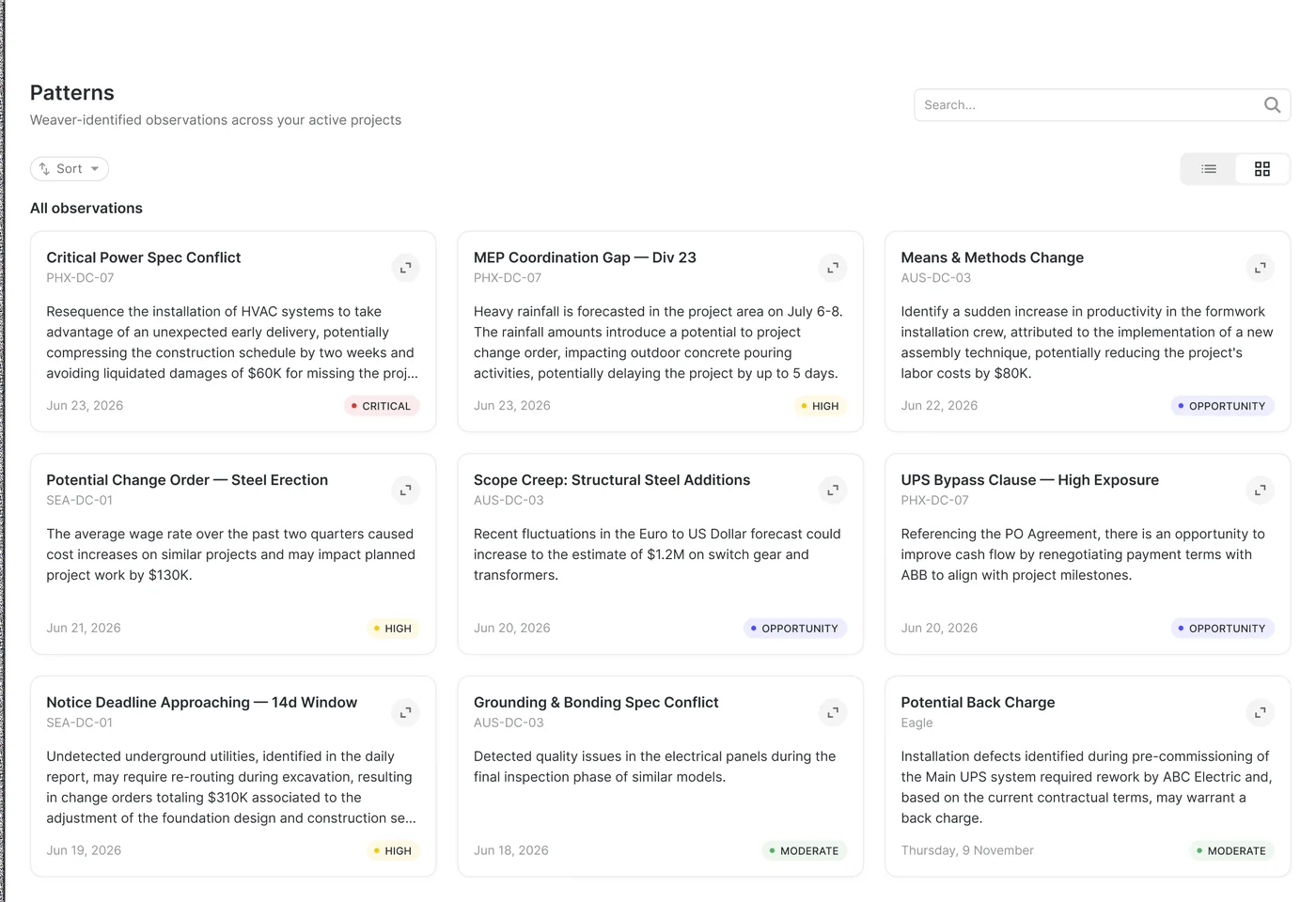
Weaver Patterns is an active monitoring system. It watches project conditions across six functional areas — continuously — and surfaces what matters before it becomes a problem. Here's what that looks like in practice.
Environmental Health and Safety
Safety data is abundant on any active project. Observation reports, near-miss logs, inspection records, training compliance — the signals are there. The problem is they rarely get connected in time to mean anything. They're reviewed after the fact, and almost never linked to the conditions that preceded an incident.
Weaver Patterns monitors leading safety indicators across your program: observation frequency, subcontractor safety histories, inspection outcomes, training status by crew and trade. For owners, that means independent visibility into safety culture without requiring GCs to self-report. For GCs, it means identifying crews or trades where conditions are trending the wrong way before an incident occurs — and having the documentation to act on it.
Scheduling
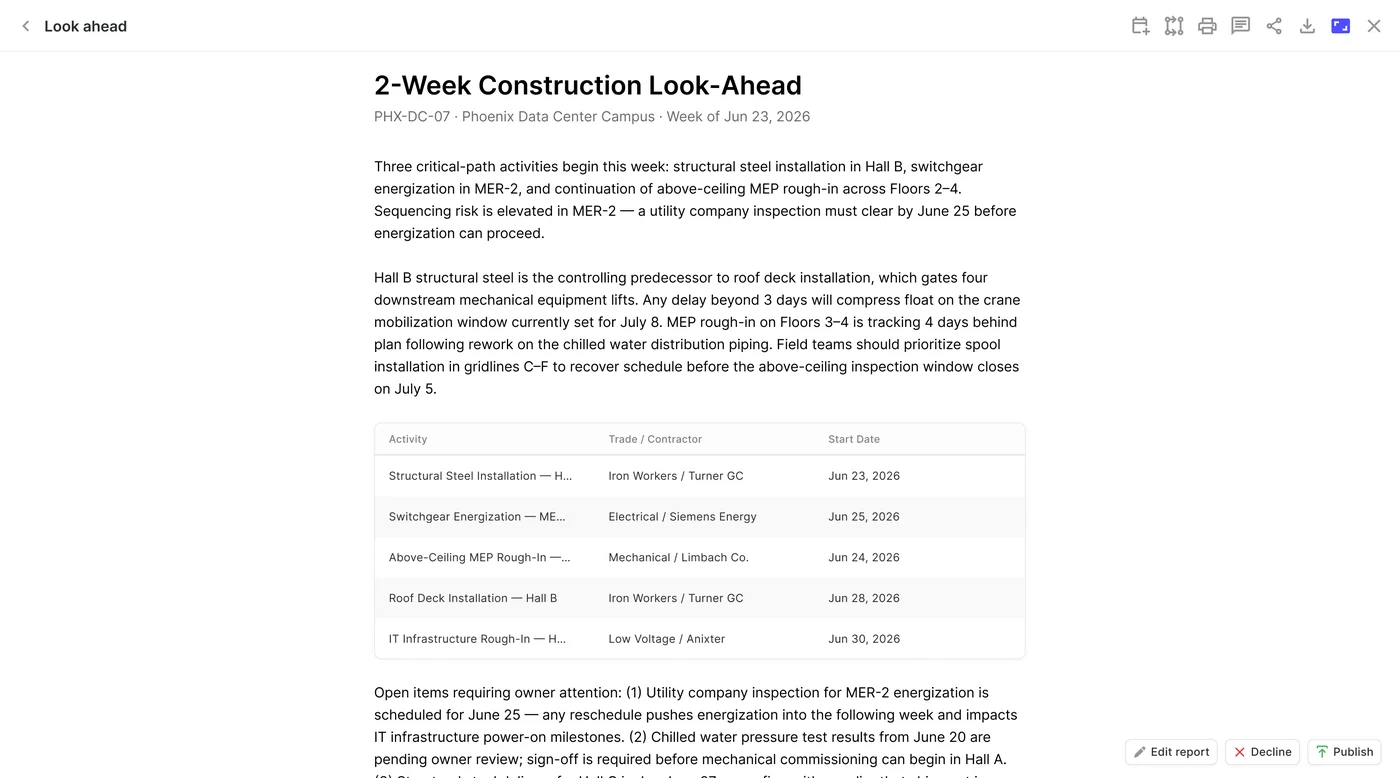
Schedule is the common language of construction. But most schedule reporting tells you what happened last week, not what's about to happen next month. A GC-submitted update shows the current milestone status. It doesn't show whether the lookahead is credible, where float is quietly being consumed, or whether the critical path has shifted since the last review.
Weaver Patterns analyzes schedule health continuously: lookahead adherence rates, float consumption trends, critical path pressure, predecessor completion patterns. Owners can validate whether a project is actually on track — not just what the latest submitted update says. GCs can see where schedule pressure is building weeks before it surfaces as a formal delay.
Financial
Cost overruns rarely appear all at once. They accumulate — through change orders that absorb contingency faster than expected, through committed costs that outpace the budget curve, through productivity rates that quietly drift below plan. By the time the trend is visible in a monthly report, the options to address it have already narrowed.
Weaver Patterns tracks financial health signals at the project and program level: contingency burn rate, cost-at-completion trend, change order velocity, budget-to-actual variance by phase. Owners get early signals when a project's financial trajectory is shifting. GCs get the context to have harder conversations earlier, when more paths are still available.
Scope Management
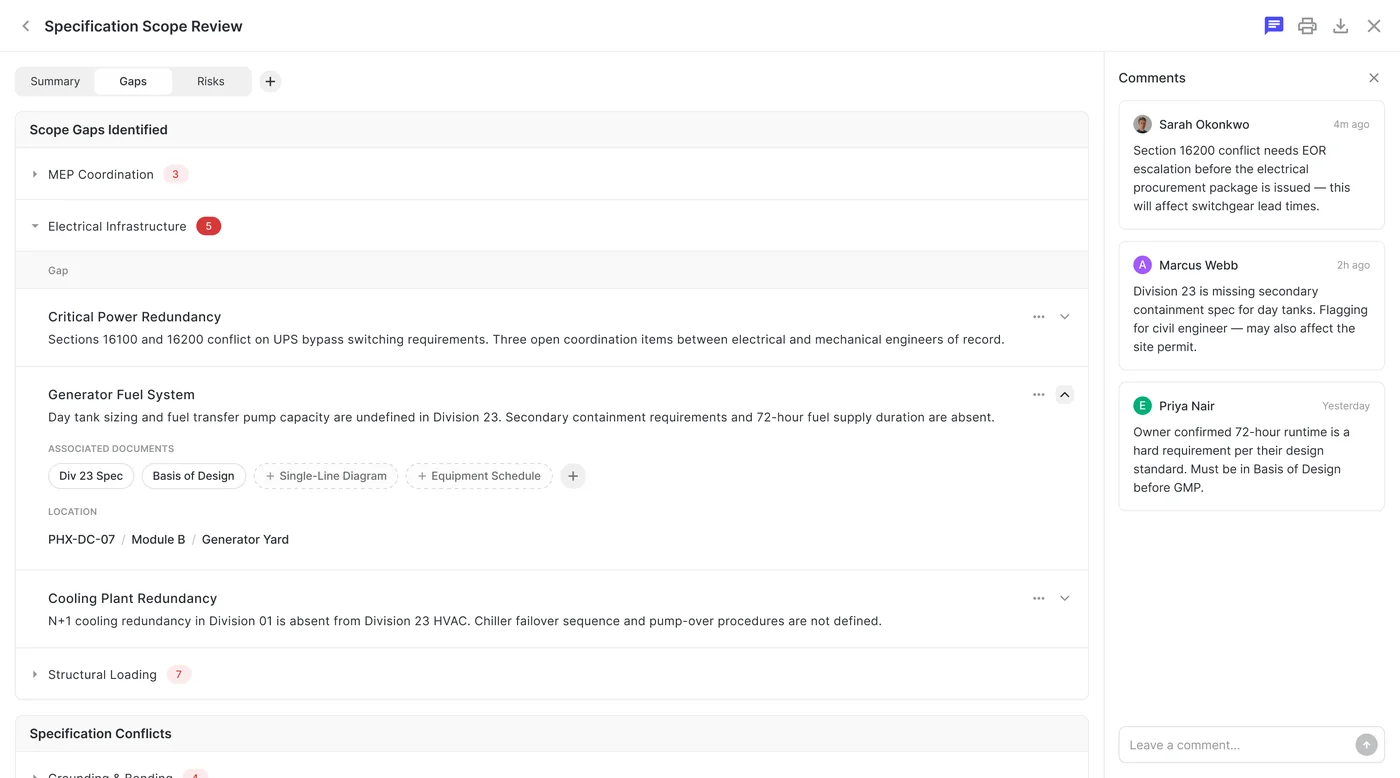
Individual scope changes look manageable in isolation. The cumulative effect is what damages programs. A change order here, an RFI cluster there, a series of design revisions that each seem minor — together they represent a pattern: the program is drifting from its original intent, and the cost and schedule implications are compounding quietly.
Weaver Patterns tracks scope changes systematically — not just their cost, but their pattern. Are changes clustering in a particular trade or phase? Is RFI volume signaling coordination gaps in the design? Are change order approval cycles creating downstream schedule pressure? Owners get a clear picture of how scope is evolving and what it means for the program. GCs get the visibility to manage scope proactively rather than defensively.
Construction
What's actually happening in the field is often the last thing to show up in a program report. Work-in-place percentages, manpower curves, materials on site, inspection outcomes — these signals tell the real story of a project's momentum. When they're not being monitored continuously, problems in the field can be weeks old by the time they surface in a status meeting.
Weaver Patterns monitors field-level conditions against what the schedule predicts should be happening: where productivity is tracking to plan, where it isn't, and where the gap is likely to widen. Owners can validate that field progress matches what they're being told. GCs can identify performance gaps early, while there's still time to recover.
Document Management
On a complex project, documents are decisions. Submittals, RFIs, drawing revisions, inspection reports — when these move slowly or get stuck in the review cycle, construction doesn't wait. Work proceeds under unclear direction. Rework follows. By the time the backlog is visible, it's already affecting the field.
Weaver Patterns monitors document flow health across the program: submittal cycle times, RFI backlog trends, overdue review queues, drawing revision rates by package. Owners gain visibility into whether their own review processes are creating bottlenecks. GCs can surface document pipeline issues that are on track to become field problems — before they do.
One Platform, Six Lenses
Together, these six areas give owners and GCs a complete picture of program health — not as a monthly snapshot, but as a continuously updated view of what’s happening and what’s coming.
Capital programs are too complex and too consequential to manage from lagged reports. Weaver Patterns is built on the premise that the right information, delivered at the right time, changes outcomes. We’re proud to make it available today — and to build on it alongside the programs that need it most.